
Online Gemology Course with Certificate: What Can and Cannot Be Learned Remotely
Online learning has opened gemology to people who could never attend a full time campus course. Working professionals, family business members and students outside major cities can now study from home. But gemology is a practical science. Some skills move to a screen easily, and some do not. This guide explains what an online gemology course with certificate can teach well, what still needs hands on practice and how hybrid study brings the two together.
Key Takeaways
- Theory, terminology, gem families and report reading learn well online.
- Instrument use, stone handling and grading judgement need supervised practical time.
- Hybrid courses combine online flexibility with in person lab sessions for complete skills.
Why Online Gemology Courses Have Grown
Online study removes the biggest barriers to gemology education: distance, time and cost. Learners can watch lessons after work, revise recorded sessions and study at their own pace. For many people in Kerala, Karnataka and across India, this makes a professional qualification possible for the first time.
Online formats also suit people already working in the trade. A sales executive or family jeweller can build knowledge without leaving the business. You can see the current options on IIJF Global’s online courses page.
What You Can Learn Well Online
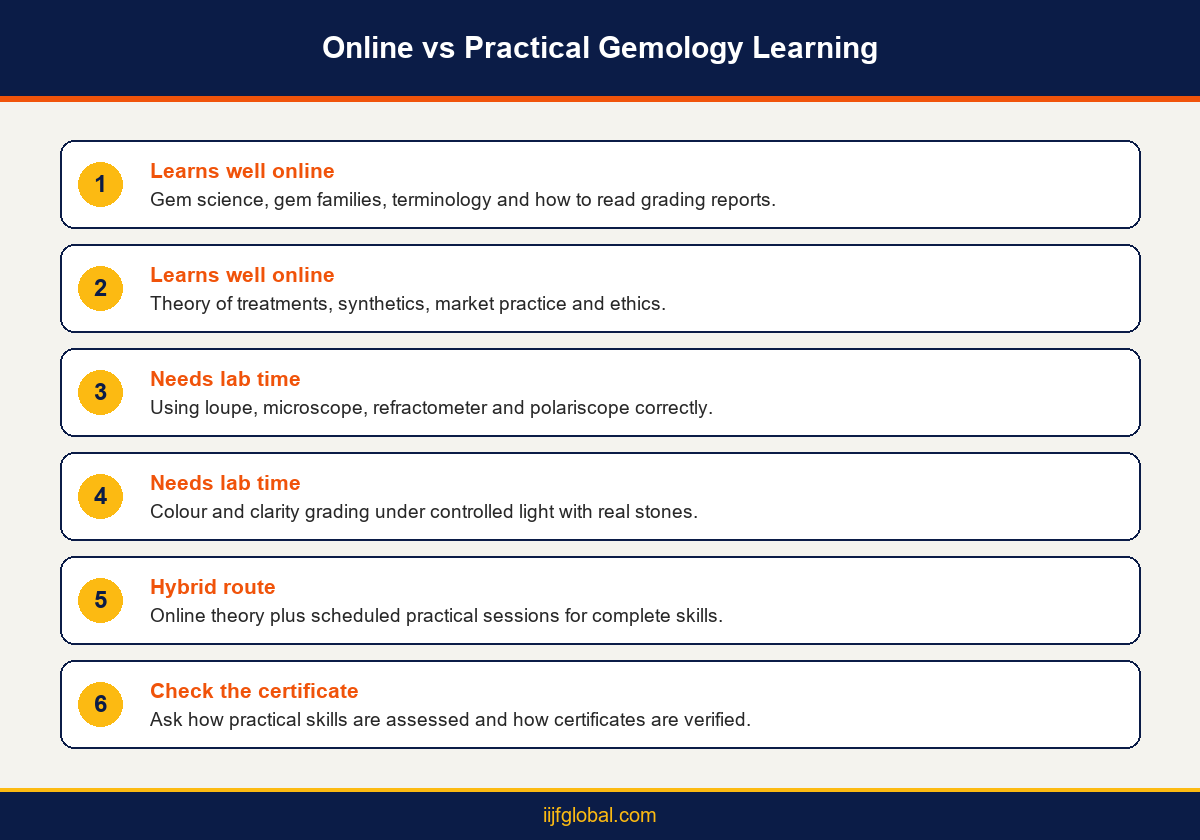
A large part of gemology is knowledge. Online study works very well for the science of how gems form, the major gem families and their properties, and the vocabulary used across the trade. Learners can understand refractive index, hardness, specific gravity and optical effects through clear lessons and diagrams.
Online study also suits learning to read grading reports, understanding treatments and synthetics in theory, and studying market practices and ethics. Our guide on how to read a diamond certificate is a good example of knowledge that transfers well to remote study.
What Is Hard to Learn Remotely
Some skills depend on your own hands and eyes. Using a loupe correctly, focusing a gemological microscope, placing a stone on a refractometer and reading a polariscope all need practice with real instruments. Videos help, but they cannot replace the moment you find a shadow line or an inclusion yourself.
Grading judgement is similar. Colour grading depends on controlled lighting and master stones. Clarity grading needs many real diamonds under magnification. Separating natural, synthetic and treated stones needs a wide range of real samples. Screens also alter colour, so judging gem colour from a photograph is unreliable.
How Online Courses Handle Practical Skills
Good online programmes are honest about these limits. Some send learners stone kits or basic tools. Others use live video sessions with trainers who demonstrate instruments in real time. Many build in compulsory practical sessions at a training centre.
When comparing courses, ask how practical skills are taught and assessed. A course that promises full professional grading skills with no hands on component deserves careful questions. Our comparison of gemology institutes in India covers more points to check before enrolling.
The Hybrid Option: Best of Both
Hybrid study combines online theory with scheduled practical sessions. Learners complete lessons remotely, then attend focused lab blocks to work with instruments and stones under supervision. This approach keeps most of the flexibility of online study while closing the practical gap.
For working professionals, hybrid study often works best. You can learn theory in the evenings and plan practical sessions around your work. IIJF Global offers hybrid courses built this way, alongside fully offline courses for those who prefer full time, in person study.
What a Certificate Should Represent
A certificate should show what you can actually do, not only what you have watched. Check what the certificate covers, how learners are assessed and whether practical skills are tested. Employers increasingly value candidates who can demonstrate instrument skills, not just theory.
Look for clear course outcomes, qualified trainers and a way to verify your certificate. IIJF Global, for example, offers a public course certificate verification page, which helps employers confirm a learner’s qualification.
Choosing the Right Format for You
If you are new to gemology and want a broad foundation, online study is a strong starting point. If you plan to grade stones professionally or work in a laboratory, choose a course with substantial practical training. If you work full time, a hybrid route usually gives the best balance.
Think about your goal first, then match the format to it. The Diploma in Gemology can be approached in different formats depending on how much practical time you need.
Conclusion
An online gemology course with certificate can teach a great deal, from gem science to report reading. Instrument skills and grading judgement, however, still need real stones and supervised practice. For most learners, a hybrid path delivers both flexibility and genuine competence. To find the right format for your goals, explore IIJF Global’s courses or talk to our team.
Frequently Asked Questions
Q1: Can I learn gemology completely online?
You can learn much of the theory online, including gem science, terminology and report reading. Instrument skills and grading judgement need hands on practice with real stones.
Q2: Is an online gemology certificate valued by employers?
It can be, especially when the course includes assessed practical skills. Employers value certificates that reflect real ability to use instruments and identify stones.
Q3: What gemology skills need in person training?
Using the loupe, microscope, refractometer and polariscope, colour and clarity grading, and separating natural, synthetic and treated stones all need supervised practical work.
Q4: What is a hybrid gemology course?
A hybrid course combines online theory lessons with scheduled in person lab sessions, so learners keep flexibility while still gaining practical instrument skills.
Q5: Can I judge gem colour from photos in an online course?
Not reliably. Screens and cameras alter colour, so colour grading needs controlled lighting and real stones, usually during practical sessions.
Q6: Who should choose an online gemology course?
Online courses suit beginners building a foundation, working professionals who need flexibility and learners outside major cities who cannot attend full time classes.
Q7: Do online gemology courses include practical kits?
Some do, while others rely on live demonstrations or practical sessions at a centre. Always ask how practical skills are taught and assessed before enrolling.
Q8: How do I check if a gemology certificate is genuine?
Ask the institute for a verification method. IIJF Global offers a public course certificate verification page so employers can confirm a learner’s qualification.
Q9: Is offline or online gemology study better?
It depends on your goal. Offline study gives the most practical time, online study gives flexibility, and hybrid study balances both for most working learners.
Q10: Does IIJF Global offer online and hybrid gemology courses?
Yes. IIJF Global offers online, hybrid and offline courses in gemology and related subjects for students and professionals.

You may also like