Handling Lab-Grown Diamond Questions in a Jewellery Showroom
Lab-grown diamonds have moved from a niche topic to a daily conversation in Indian showrooms. Customers ask whether they are real, why they cost less and whether they will hold value. How staff answer these questions shapes trust in the whole store. A confused or evasive reply can lose a sale. A misleading one can lose a customer for good. This guide shows sales teams how to handle lab-grown diamond questions clearly, honestly and with the right facts.
Key Takeaways
- Lab-grown diamonds are real diamonds made in a factory, not imitations, so staff should describe them accurately.
- Clear disclosure on tags, invoices and certificates is essential for both natural and lab-grown stones.
- Honest answers on value and resale build more trust than any sales pitch.
Why Showroom Teams Need a Clear Answer
Customers often arrive with half formed ideas from social media. Some think lab-grown diamonds are fake. Others believe they are identical in every way, including value. Staff who cannot explain the difference simply end up repeating what customers already believe.
A well trained team gives the same accurate answer every time. That consistency protects the store from complaints and helps customers choose with confidence, whichever stone they prefer. It also reflects the ethical selling approach at the core of good jewellery retail sales training.
Question One: Are Lab-Grown Diamonds Real?
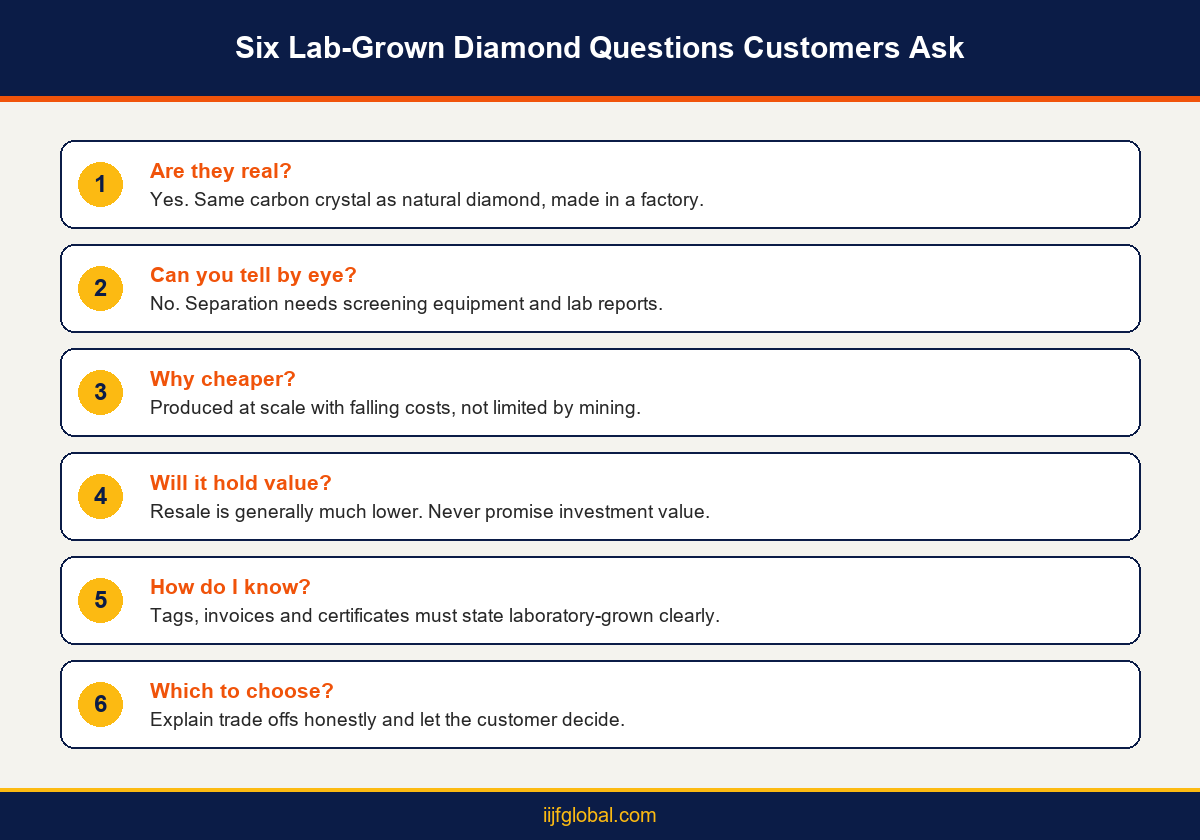
The honest answer is yes. A lab-grown diamond has the same carbon crystal structure and the same physical and optical properties as a mined diamond. It is not a simulant like cubic zirconia or moissanite, which are different materials altogether.
The difference is origin. Natural diamonds form deep in the earth over very long periods. Lab-grown diamonds are made in factories, mainly by CVD or HPHT methods, in a matter of weeks. Staff should explain both points clearly and avoid calling either stone fake.
Question Two: Can You Tell the Difference?
To the naked eye, and even under a loupe, a lab-grown diamond and a natural diamond usually look the same. Separating them reliably requires specialist screening equipment and laboratory testing.
This is why certificates and disclosure matter so much. A reputable grading report states clearly whether a diamond is natural or laboratory-grown, and many lab-grown stones carry a laser inscription. Staff should know how to read these reports, as covered in our guide on how to read a diamond certificate.
Question Three: Why Is It Cheaper?
Lab-grown diamonds cost less mainly because they can be produced at scale, and production costs have fallen. Supply is not limited by mining in the way natural diamond supply is.
Staff should present price differences factually, without suggesting that one choice is foolish. Some customers want the largest stone for their budget. Others value natural origin and rarity. Both are valid reasons, and a good consultant helps each customer find the right fit.
Question Four: Will It Hold Its Value?
This is where honesty matters most. Lab-grown diamond prices have fallen over time as production grew, and resale value is generally much lower than for natural diamonds. Staff should not promise resale or investment value they cannot support.
For a fuller comparison, our guide to natural vs lab-grown diamonds and long term value explains how the two markets behave. Pointing customers to clear information builds credibility, even when it does not lead to the highest sale.
Question Five: How Will I Know What I Am Buying?
Clear disclosure answers this question. Tags, invoices and certificates should state plainly whether a stone is natural or laboratory-grown. Vague terms that blur the difference should be avoided. India has also tightened rules on how diamonds may be described, as explained in our article on India’s new diamond rule.
Stores should build disclosure into every step, from display cards to the final invoice. When a customer later checks the certificate, it should match exactly what the staff member said on the showroom floor.
Question Six: Which Should I Choose?
There is no single right answer. Staff should ask about the customer’s budget, the occasion, how long they plan to keep the piece and how much natural origin matters to them. Then they should explain the trade offs clearly and let the customer decide.
Pressure selling either type damages trust. A customer who chooses with full information is far more likely to return, recommend the store and stay loyal. Industry bodies such as the Gem and Jewellery Export Promotion Council also emphasise transparency as key to consumer confidence in India’s diamond trade.
Building This Into Staff Training
Answers like these should not depend on which staff member a customer meets. Stores benefit from short, structured training that covers the facts, the disclosure rules and practice conversations. Role play helps staff stay calm when customers challenge them.
IIJF Global’s corporate training programmes help jewellery brands prepare sales teams for exactly these conversations, alongside wider product knowledge and ethical selling skills.
Conclusion
Lab-grown diamond questions are an opportunity to show expertise and honesty. Explain that lab-grown stones are real diamonds with a different origin, be clear about price and value, disclose everything in writing and let customers choose freely. To train your team in confident, ethical diamond conversations, explore the Diploma in Jewelry Retail Sales Management or contact IIJF Global.
Frequently Asked Questions
Q1: Are lab-grown diamonds real diamonds?
Yes. Lab-grown diamonds have the same carbon crystal structure and properties as mined diamonds. They differ only in origin, as they are made in factories rather than formed in the earth.
Q2: Is a lab-grown diamond the same as cubic zirconia or moissanite?
No. Cubic zirconia and moissanite are different materials that imitate diamond. A lab-grown diamond is actual diamond, chemically and physically.
Q3: Can a jeweller tell a lab-grown diamond apart by eye?
No. They usually look identical, even under a loupe. Reliable separation needs specialist screening equipment and laboratory testing, which is why certificates matter.
Q4: Why are lab-grown diamonds cheaper than natural diamonds?
They can be produced at scale, and production costs have fallen over time. Their supply is not limited by mining, which keeps prices lower than natural diamonds.
Q5: Do lab-grown diamonds have resale value?
Resale value is generally much lower than for natural diamonds, and prices have fallen over time. Staff should never promise investment value for lab-grown stones.
Q6: How should lab-grown diamonds be labelled in a store?
Tags, invoices and certificates should state clearly that the stone is laboratory-grown. Vague wording that blurs natural and lab-grown origin should be avoided.
Q7: Do lab-grown diamonds come with certificates?
Many do. Reputable labs issue grading reports for lab-grown diamonds that clearly state their origin, and many stones carry a laser inscription linking them to the report.
Q8: How should staff respond if a customer says lab-grown diamonds are fake?
Explain calmly that lab-grown diamonds are real diamonds with a factory origin, then outline the differences in price, value and rarity so the customer can decide.
Q9: Should sales staff recommend natural or lab-grown diamonds?
Staff should understand the customer’s budget and priorities, explain the trade offs honestly and let the customer choose, rather than pushing either type.
Q10: How can a jewellery brand train staff on lab-grown diamonds?
Structured product knowledge training with role play works best. IIJF Global offers corporate training for jewellery sales teams covering diamonds and ethical selling.