2027 Jewelry Authentication: Why Forensic Gemology Certification Is Becoming Industry-Mandatory
Proof now matters as much as sparkle in the jewelry trade, and India’s mandatory gold hallmarking framework from the Bureau of Indian Standards shows how far verification rules have already come. A gemology diploma course was once a nice extra on a jeweler’s CV. Today it is fast becoming the baseline for anyone who grades, buys, sells or insures stones. If you are weighing this path, you can speak with the IIJF team at any stage. This guide explains why forensic gemology certification is heading toward industry standard status, what the data says, and how to prepare for 2027.
Key Takeaways
- Disclosure rules in India and abroad now require sellers to prove what a stone or metal really is, which only trained people can do.
- A gemology diploma course with forensic depth gives you the detection skills that new labelling and treatment rules depend on.
- A diploma in gemology and jewelry forensics 2027 intake can position you ahead of employers who will expect verified, certified staff.
Why Authentication Rules Are Tightening
In short: regulators and buyers no longer accept a seller’s word. India has made gold hallmarking mandatory, set strict diamond naming rules, and global markets demand clear disclosure of lab grown stones and treatments. Each rule creates a need for trained people who can test and confirm what is sold.
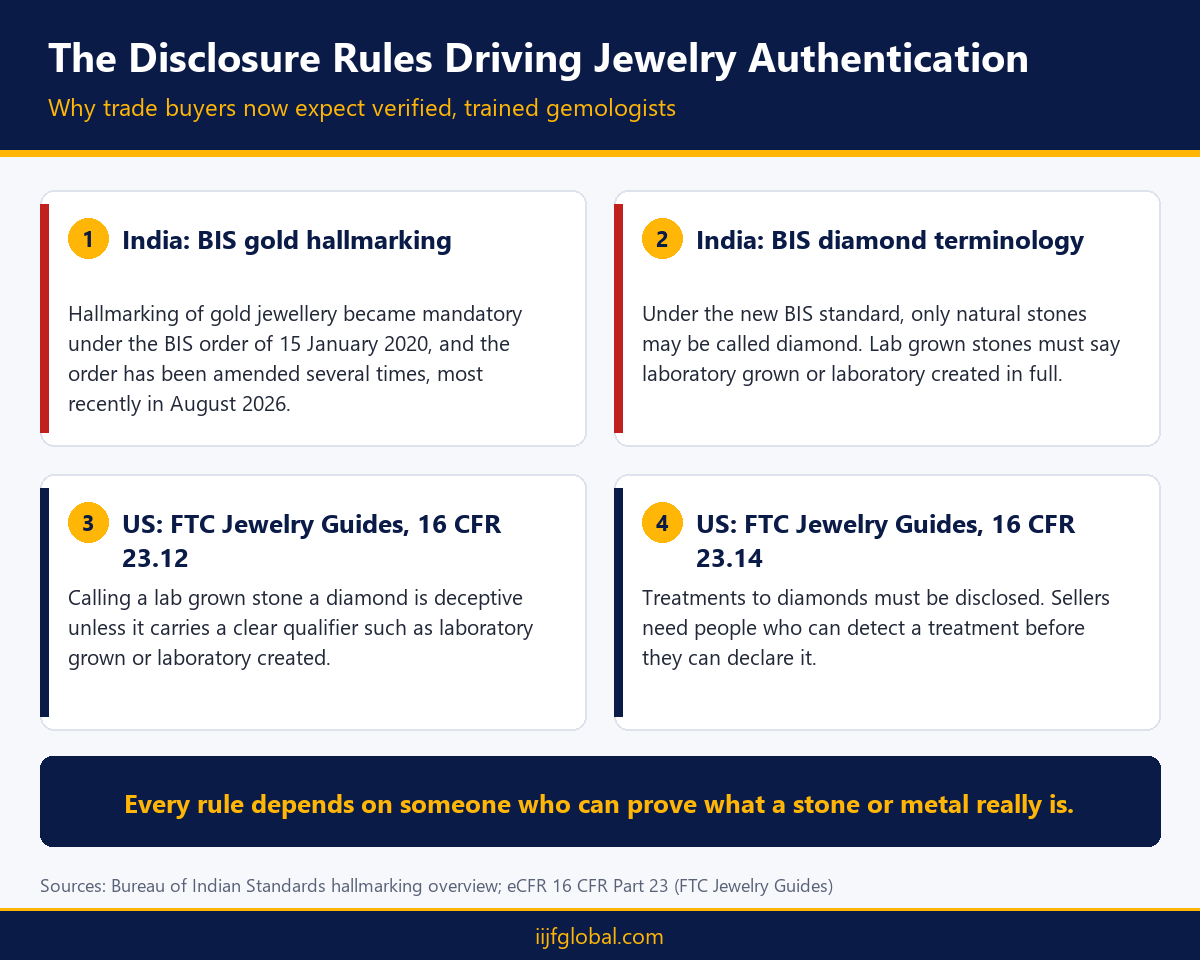
The Bureau of Indian Standards issued its mandatory hallmarking order on 15 January 2020. The order has since been amended several times, most recently in August 2026, according to the BIS hallmarking overview. Diamonds now face similar scrutiny. Under India’s new diamond naming rule, only natural stones may be called diamond, and lab grown stones must carry the full qualifier.
Abroad, the picture is the same. The US Federal Trade Commission’s Jewelry Guides in 16 CFR Part 23 say it is deceptive to call a lab grown stone a diamond without a clear qualifier such as laboratory grown. The same guides require disclosure of treatments to diamonds. A label is only as honest as the person who checked the stone. That is why a gemology diploma course with real forensic training is moving from optional to expected.
For Indian jewelers, these rules land on the shop floor every day. Staff must explain hallmarks to customers, confirm that diamond descriptions use the right terms, and flag any stone that needs lab testing. Businesses that cannot show this competence face real risk to their reputation and to customer trust.
What the Trade Data Tells Us
In short: India sits at the centre of the world’s diamond and lab grown trade. When one country handles such a large share of global stones, the need for reliable identification grows with every shipment. The numbers below come from GJEPC trade statistics for 2024.
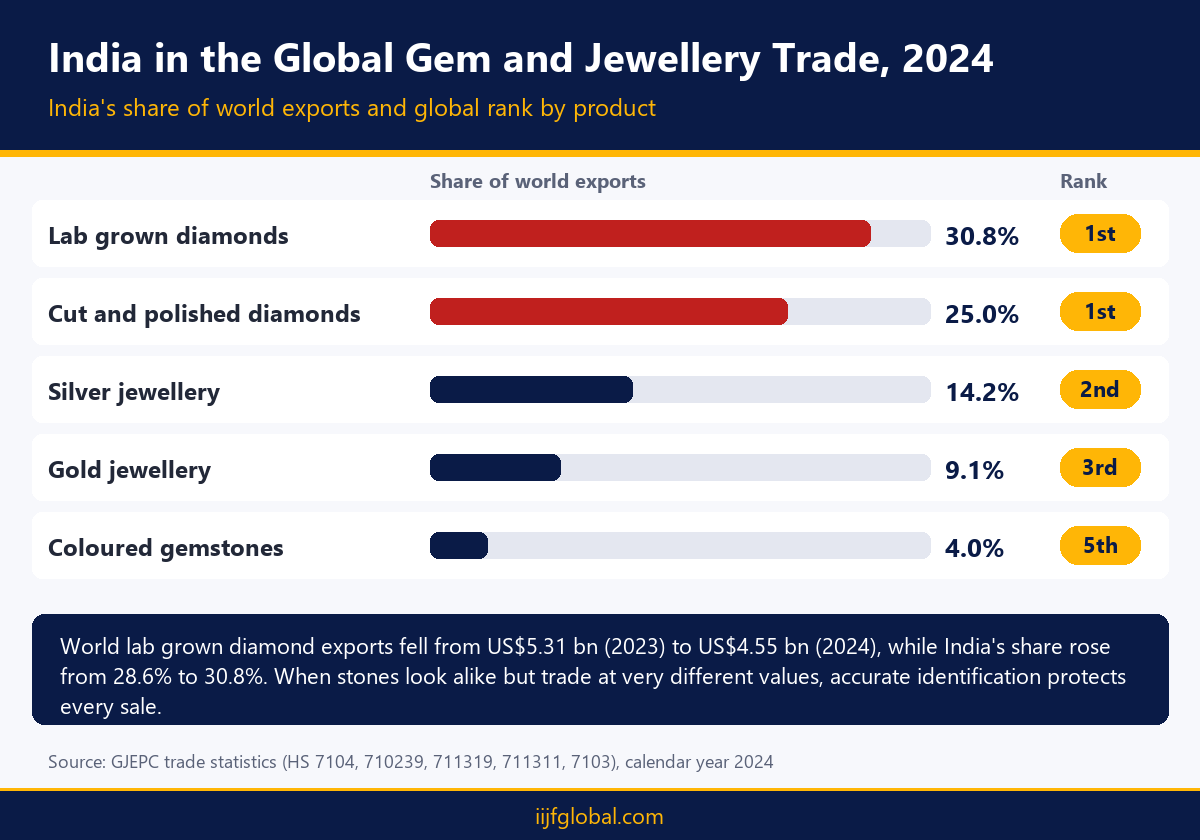
According to the Gem and Jewellery Export Promotion Council trade statistics, India ranked first in the world for cut and polished diamond exports in 2024. It shipped US$13.70 billion of a US$54.86 billion world market, a 25% share. India also ranked first for lab grown diamonds and synthetic stones, with US$1.40 billion of US$4.55 billion in world exports, or 30.8%.
The lab grown segment is shifting quickly. World exports in that category fell from US$5.31 billion in 2023 to US$4.55 billion in 2024, yet India’s share rose from 28.6% to 30.8%. Natural and lab grown diamonds look identical to the eye but trade at very different values. That gap is exactly where errors and fraud happen. Students planning a diploma in gemology and jewelry forensics 2027 start will enter a market where this skill is in daily use.
The same GJEPC data shows India ranked third in world gold jewellery exports in 2024 with a 9.1% share, and fifth in coloured gemstones with 4%. Gold brings hallmarking duties, and coloured stones bring treatment questions. Together they show why a gemology diploma course that covers metals as well as stones offers such broad value.
Why Certification Is Becoming the Industry Standard
In short: no single law yet says every jeweler must hold a gemology certificate. But every disclosure rule assumes someone can verify a stone. Employers, insurers and labs increasingly fill that role with certified people, which makes formal training a practical requirement rather than a legal one.
Think about how a modern jewelry business runs. A retailer must label lab grown stones correctly. An insurer must value a claim fairly. A buyer must confirm that a stone matches its report. Each task depends on detection skills, such as reading growth features, spotting fracture filling, and using a refractometer and polariscope with confidence. You can read more about what jewelry forensics involves in our earlier guide.
Experience alone can no longer keep pace. Treatments improve and synthetics get harder to separate from natural stones. A structured gemology diploma course gives you tested methods, supervised practice and a credential that employers can verify. This is also why IIJF offers corporate training for retail teams at jewelry brands. The outlook for 2027 points one way: verified skill will count for more than years on the shop floor.
Certification also protects the professional. When a dispute arises over a stone, a documented qualification and a clear testing record carry far more weight than personal opinion. Buyers, insurers and courts all look for evidence, and trained gemologists know how to provide it.
Skills a Forensic Gemology Programme Should Teach
In short: a strong programme goes beyond the basics of grading. It should teach you to separate natural, treated and synthetic stones, test precious metals, and write clear reports. Look for real instruments, real stones and trainers with lab experience.
Start with identification. You should learn to separate natural from lab grown diamonds and to spot common treatments in rubies, sapphires and emeralds. Next comes diamond grading training, since grading and forensics work hand in hand. Precious metal testing and jewelry quality control complete the toolkit, because hallmarking makes metal purity a daily concern.
Reporting matters just as much. A forensic finding must be clear, repeatable and defensible, whether it goes to a buyer, an insurer or a court. Good courses also teach you to check documents, including gemstone certificate verification. When you search for a certified gemologist course near me India, compare lab hours, instruments and assessment methods before you compare anything else.
How to Choose the Right Course for 2027
In short: pick a course that treats forensics as a full subject, offers flexible study formats, and is led by trainers who have worked in recognised labs. Plan early so you can secure a place in a 2027 batch.
At IIJF, founder Jerin Joy brings a 14 year career with laboratories and organisations including GIA, IGI, SGL, MTGL and IIG. Our Diploma in Jewelry Forensics covers diamonds, gemology, precious metals and jewelry quality control. Courses run online, offline and in hybrid formats, so working professionals and students can both take part. Our flagship gemstone identification programme is a strong starting point for newcomers.
Before you enrol in any gemology diploma course, ask three questions. How many hours will I spend on real stones? Which instruments will I learn to use? How will my detection skills be assessed? If you want a certified gemologist course near me India with flexible study options, these answers will tell you whether a programme can prepare you for the authentication demands ahead.
This path suits several kinds of learners. Graduates can build a specialist career from day one. Retail staff can move into grading, buying or quality roles. Family jewelers can bring testing skills in house and protect their own stock. Whatever your starting point, a gemology diploma course built on forensic science gives you a skill set the trade will keep needing.
Conclusion
Jewelry authentication is no longer a back office task. Hallmarking orders, diamond naming rules and global disclosure guides all depend on people who can prove what a stone or metal really is. India’s leading role in diamond and lab grown exports makes that skill even more valuable here. A gemology diploma course with genuine forensic depth is the clearest way to meet these expectations and build a career that lasts beyond 2027. To plan your next step, explore all our courses or contact the IIJF team today.
Frequently Asked Questions
Q1: Is forensic gemology certification legally mandatory in India?
No single law yet requires every jeweler to hold a gemology certificate. However, mandatory hallmarking and strict diamond naming rules mean businesses must verify what they sell, so employers increasingly treat certified, trained staff as a practical requirement.
Q2: What will I learn in a gemology diploma course?
A good gemology diploma course teaches gemstone identification, diamond grading, detection of treatments and lab grown stones, and the use of instruments such as the refractometer and polariscope. Forensic programmes also cover precious metal testing and clear, defensible reporting.
Q3: How is jewelry forensics different from regular gemology?
Regular gemology identifies and grades stones. Jewelry forensics goes further, proving whether a stone is natural, treated or synthetic, checking it against its documents, and recording evidence that can stand up to buyers, insurers or a court.
Q4: Can a trained gemologist tell lab grown diamonds from natural ones?
Yes, with the right training and instruments. Natural and lab grown diamonds look identical to the eye, so gemologists study growth features, inclusions and reactions to light, and refer difficult stones to advanced lab testing when needed.
Q5: Why is India important for jewelry authentication careers?
India ranked first in world exports of both cut and polished diamonds and lab grown diamonds in 2024, according to GJEPC data. Such a large share of global trade creates steady demand for professionals who can identify stones accurately.
Q6: Can I study a diploma in gemology and jewelry forensics 2027 online?
Yes. IIJF runs courses in online, offline and hybrid formats, so you can choose what fits your schedule and location. Browse our online courses to see the current options, then speak with our team before planning your 2027 start.
Q7: How do I choose a certified gemologist course near me India?
Compare lab hours, the instruments you will use, how detection skills are assessed, and the trainers’ industry experience. A course that treats forensics as a full subject, rather than a short module, gives you stronger and more credible skills.
Q8: Who teaches at IIJF?
IIJF was founded by Jerin Joy, whose 14 year career includes work with GIA, IGI, SGL, MTGL and IIG. Learn more about our founder, directors and educators on the about us page before you enrol.
Q9: Who should consider a gemology diploma course?
Graduates seeking a specialist career, retail staff aiming for grading or buying roles, family jewelers who want in house testing skills, and professionals in insurance or appraisal all benefit. The course suits anyone who enjoys detail and careful evidence.
Q10: Does gemology training help with gold hallmarking compliance?
Yes. Training that covers precious metals helps you understand purity marks, explain hallmarks to customers and spot pieces that need testing. With hallmarking now mandatory for gold jewellery in India, this knowledge supports everyday compliance on the shop floor.