
Navratna Gemstone Identification: Nine Gems, Substitutes and Quality Checks
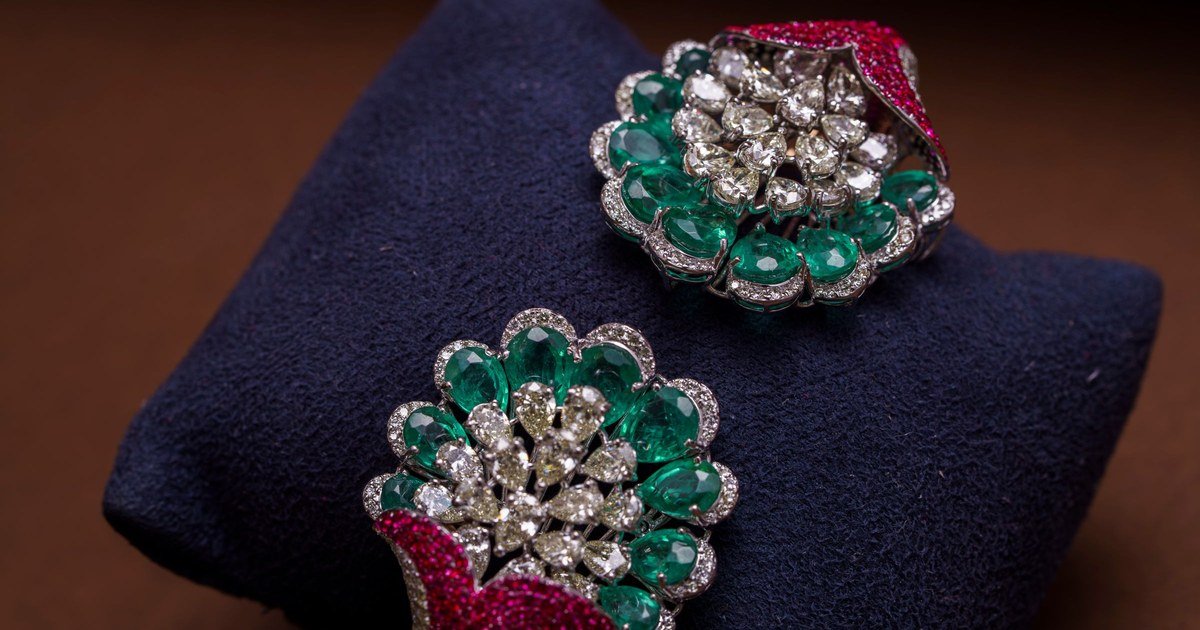
Navratna jewellery holds a special place in Indian culture. It brings together nine gems in one piece, each traditionally linked to a celestial body. For customers, the meaning matters. For jewellers and gemologists, the job is to make sure each stone is exactly what it claims to be. This guide explains the nine Navratna gems, the substitutes often sold in their place and the quality checks professionals use for reliable identification.
Key Takeaways
- The nine Navratna gems are ruby, pearl, red coral, emerald, yellow sapphire, diamond, blue sapphire, hessonite and cat’s eye.
- Lower cost substitutes and imitations are common, so each stone needs its own identification check.
- Professionals separate cultural meaning from gemological evidence and disclose every substitute clearly.
What Navratna Means
Navratna means “nine gems”. In traditional arrangements, each gem is associated with a planet or celestial body in Vedic astrology. The ruby usually sits at the centre, linked to the Sun, with the other eight around it.
Customers buy Navratna pieces for faith, tradition and beauty. Whatever the reason, they deserve accurate information about the stones. A jeweller’s role is not to judge belief, but to make sure the gems are correctly identified and fairly described, which builds lasting trust.
The Nine Navratna Gems
The traditional nine gems are ruby (Manik), linked to the Sun; pearl (Moti), linked to the Moon; red coral (Moonga), linked to Mars; emerald (Panna), linked to Mercury; and yellow sapphire (Pukhraj), linked to Jupiter. The set continues with diamond (Heera), linked to Venus; blue sapphire (Neelam), linked to Saturn; hessonite garnet (Gomed), linked to Rahu; and chrysoberyl cat’s eye (Lehsunia), linked to Ketu.
These stones come from very different gem families. Ruby and both sapphires are corundum. Pearl and coral are organic. Hessonite is a garnet, and true cat’s eye is chrysoberyl. Each family needs different identification methods, which is why Navratna work is a useful test of a gemologist’s range.
Common Substitutes and Imitations
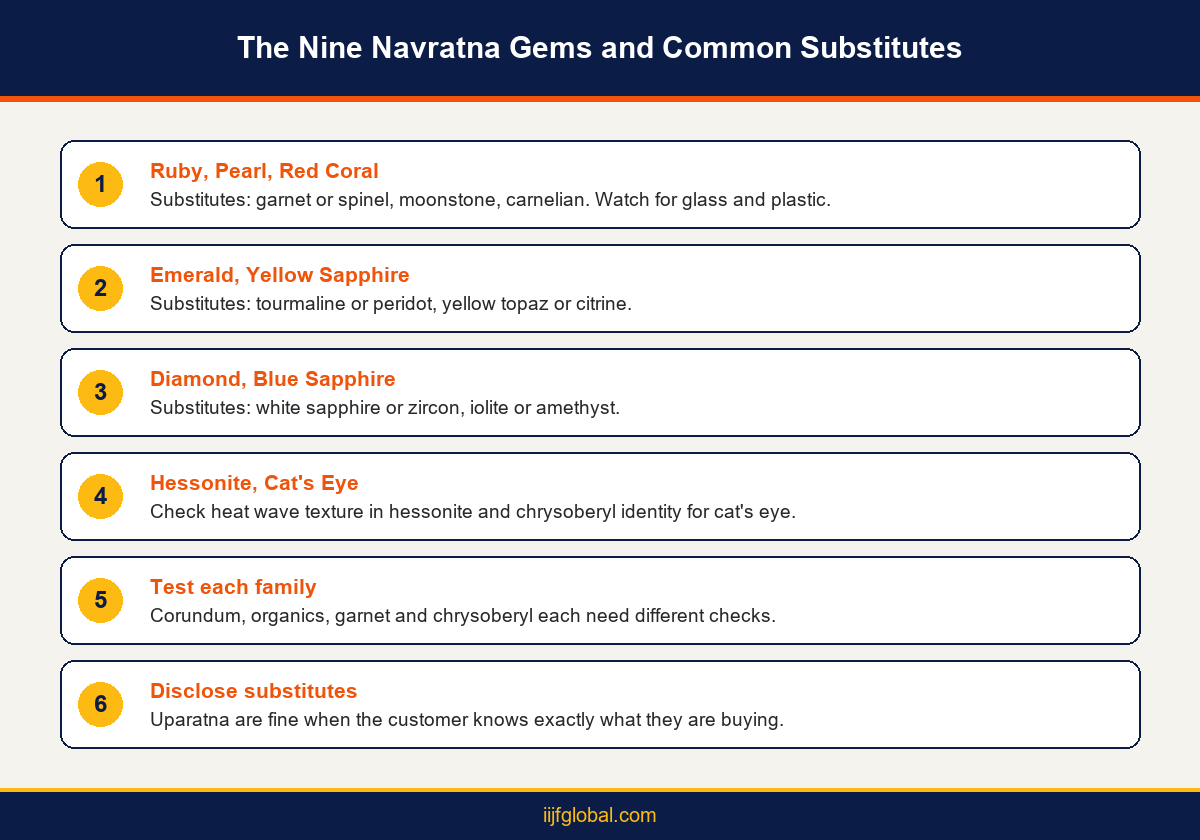
Lower cost stones, often called uparatna, are sometimes used in place of the main gems. Common examples include garnet or spinel for ruby, moonstone for pearl, carnelian for red coral, green tourmaline or peridot for emerald, yellow topaz or citrine for yellow sapphire, white sapphire or zircon for diamond, and iolite or amethyst for blue sapphire.
Substitutes are not wrong in themselves. Many customers knowingly choose them for budget reasons. The problem arises when a substitute, imitation or synthetic is sold as the real gem. Glass, plastic and synthetic stones also appear in the market, especially in low priced pieces.
Quality Checks for Each Stone Type
Corundum stones such as ruby and sapphires are checked with a refractometer, polariscope and microscope, looking at refractive index, inclusions and signs of heat or glass filling. Glass filled rubies need special attention, because heavy glass filling sharply reduces both durability and value.
Organic gems need different care. Pearls must be checked for natural, cultured or imitation origin, which can require laboratory X-ray testing. Red coral can be imitated with glass, plastic or reconstructed material, and acids can damage it, so tests must be gentle. For cat’s eye, the sharp, centred band of light, called chatoyancy, should be checked along with the stone’s identity, since quartz cat’s eye and fibre optic glass can mimic chrysoberyl.
Diamond and Hessonite Checks
The diamond in a Navratna piece is often small, which makes simulants easier to slip in. Thermal and electrical testers help screen it, and a loupe can show signs such as rounded facet edges in softer simulants.
Hessonite is a garnet with a warm orange to brown colour. It often shows a distinctive swirly or heat wave texture inside under magnification. Its refractive index and singly refractive behaviour in the polariscope help separate it from look alike stones.
Setting and Metal Matter Too
Navratna pieces are often set in gold, and the metal deserves the same care as the stones. Check the BIS hallmark and HUID, and confirm the invoice matches the piece. Closed back settings, common in traditional designs, can hide foil or low quality stones, so look closely.
Traditional arrangements also follow a set order, with ruby in the centre. A professional checks both the gem identities and the layout the customer expects.
Balancing Belief and Evidence
Navratna sits where culture and science meet. A professional approach respects customers’ beliefs while staying firmly evidence based about the stones. That means describing gems by their gemological identity, disclosing treatments and substitutes, and never making claims that cannot be supported.
This balanced approach is at the heart of the Diploma in Navratna and Astrogemology, which teaches traditional knowledge alongside practical identification. You can read more about the course structure in our Navratna astrogemology course overview.
Conclusion
Navratna jewellery deserves the same careful gemology as any fine piece. Know the nine gems, recognise common substitutes, apply the right test to each stone family and disclose everything clearly. Respect for tradition and respect for evidence work best together. To learn Navratna identification with real stones, explore IIJF Global’s courses or contact our team.
Frequently Asked Questions
Q1: What are the nine Navratna gems?
The nine gems are ruby, pearl, red coral, emerald, yellow sapphire, diamond, blue sapphire, hessonite garnet and chrysoberyl cat’s eye, each traditionally linked to a celestial body.
Q2: Which gem sits at the centre of a Navratna piece?
In traditional arrangements, the ruby, linked to the Sun, sits at the centre, with the other eight gems placed around it in a set order.
Q3: What are Navratna substitutes or uparatna?
They are lower cost stones used in place of the main gems, such as garnet for ruby, moonstone for pearl or yellow topaz for yellow sapphire. They must be clearly disclosed.
Q4: How can I tell if a Navratna ruby is genuine?
A gemologist checks refractive index, polariscope reaction and inclusions, and looks for signs of glass filling or synthetic origin. Doubtful stones should go to a laboratory.
Q5: How are pearls in Navratna jewellery tested?
Pearls are checked for natural, cultured or imitation origin. Surface and drill hole checks help, but separating natural from cultured pearls often needs laboratory X-ray testing.
Q6: Why is red coral difficult to test?
Coral is organic and soft, and it can be imitated with glass, plastic or reconstructed material. Acids can damage it, so testing must be careful and non destructive.
Q7: What is real cat’s eye in Navratna?
The traditional cat’s eye is chrysoberyl showing a sharp band of light called chatoyancy. Quartz cat’s eye and fibre optic glass can imitate it and must be separated.
Q8: Are synthetic stones used in Navratna jewellery?
Yes, especially in low priced pieces. Synthetic ruby, sapphire and spinel are common, which is why each stone needs proper identification rather than visual judgement.
Q9: Should jewellers make astrological claims about Navratna?
A professional approach respects beliefs but describes stones by their gemological identity and avoids claims that cannot be supported by evidence.
Q10: Where can I study Navratna and astrogemology?
IIJF Global offers a Diploma in Navratna and Astrogemology that combines traditional knowledge with practical gem identification.